日期:2026/02/04 IAE
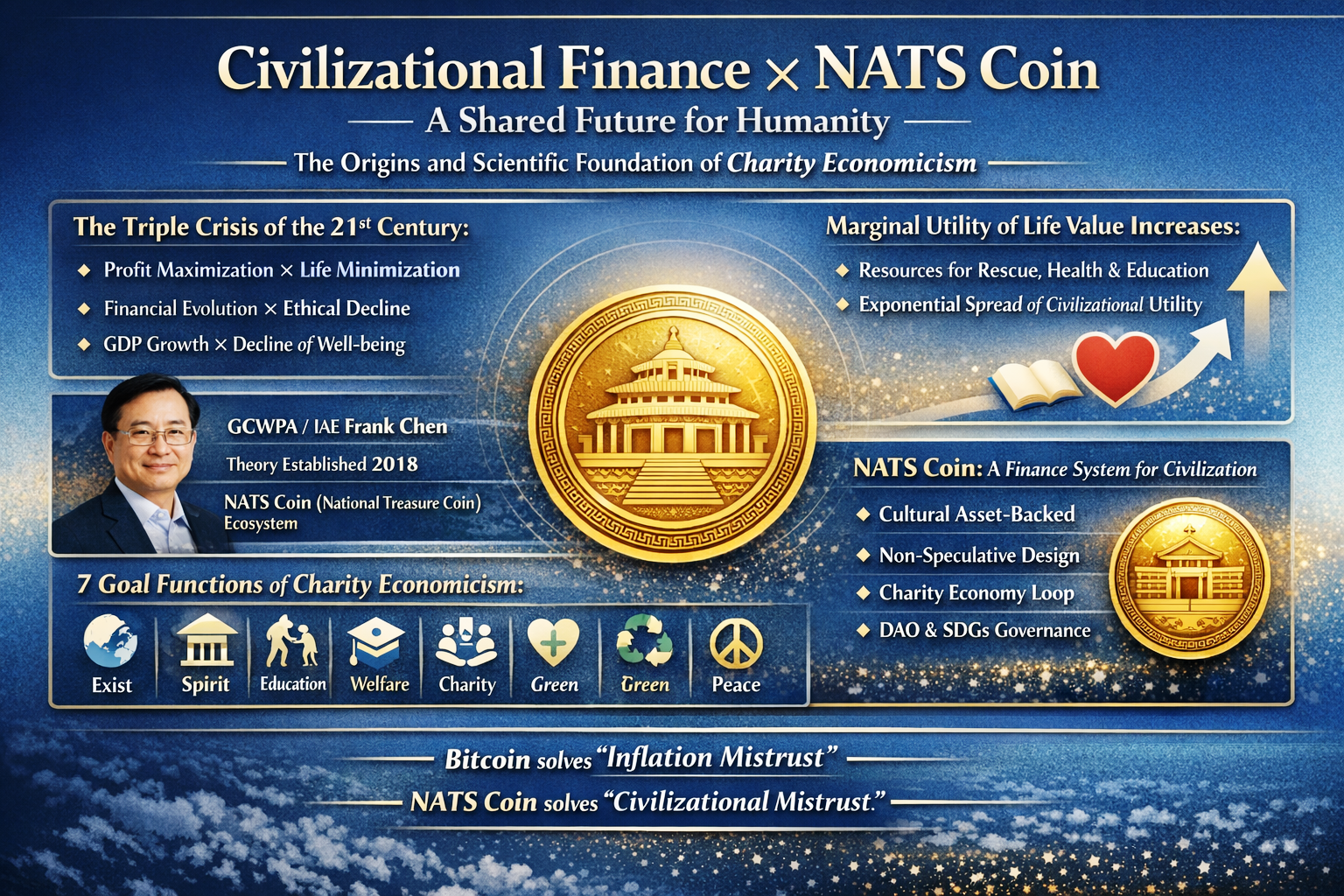
Civilizational Finance × NATS Coin
— The Theoretical Origins and Scientific Methodological Foundations of Charity Economicism
Author|GCWPA / IAE Frank Chen
Theoretical Foundation|2018
Applied System|NATS Coin (National Treasure Coin) – Civilizational Finance Framework
Civilizational Finance × NATS Coin
A Shared Future for Humanity
Charity Economicism is a civilizational economic theory formally established in 2018.
It represents a structural departure from traditional capital-centered financial models and introduces a value system in which human life, spiritual civilization, and long-term social sustainability constitute the core objectives of economic design.
Civilizational Finance extends beyond profit optimization and market efficiency.
Its primary concern is whether a financial system can support the continuity, stability, and ethical coherence of human civilization itself.
The Fundamental Question
Why does modern finance, despite its technological sophistication, repeatedly fail to prevent global crises?
The reason lies in its foundational assumptions:
-
Profit maximization as the supreme objective
-
Marginal utility of life implicitly treated as diminishing
-
Financial growth decoupled from ethical and civilizational responsibility
Charity Economicism challenges these assumptions at their root.
The Core Theoretical Breakthrough
Marginal Utility of Life Value Increases
Charity Economicism introduces a new economic law:
When resources are directed toward life preservation, education, health, dignity, and spiritual stability,
the marginal utility of such investments does not diminish—it increases exponentially at the civilizational level.
This principle has been empirically validated across public health systems, universal education models, social safety networks, and charitable economic ecosystems.
The Seven Objective Functions of Charity Economicism
The civilizational utility function can be formally expressed as:
Max F = {Exist, Spirit, Education, Charity, Welfare, Green, Peace}
| Dimension |
Civilizational Meaning |
| Exist |
Survival rights and human dignity |
| Spirit |
Psychological stability and civilizational identity |
| Education |
Accessibility and intergenerational mobility |
| Charity |
Mutual aid and common-good circulation |
| Welfare |
Social security and systemic risk buffering |
| Green |
Ecological sustainability and long-term cost control |
| Peace |
Conflict reduction and global stability |
This framework operates at the civilizational level, not the consumer preference level.
Why Blockchain Is Essential
Blockchain is not merely a financial technology—it is a civilizational governance infrastructure.
-
Immutability ensures civilizational credibility
-
Transparency guarantees accountability of public and charitable resources
-
Decentralization prevents monopolization of civilizational values
As a result, Civilizational Finance can only be realized within a Web3 architecture.
NATS Coin: The First Complete Implementation of Civilizational Finance
NATS Coin is not a speculative digital asset.
It is the world’s first financial system anchored in civilizational value consensus rather than price volatility.
Its defining characteristics include:
-
Civilizational value anchoring through irreplaceable cultural and spiritual heritage
-
Non-speculative native design prioritizing long-term trust
-
Closed-loop charity economy integrating finance, governance, and value feedback
-
DAO-based governance aligned with the UN Sustainable Development Goals (SDGs)
Conclusion
Bitcoin addresses distrust in inflationary monetary systems.
NATS Coin addresses distrust in civilizational continuity.
Charity Economicism is neither idealism nor moral rhetoric.
It is a scientifically structured response to humanity’s civilizational threshold.
Civilizational Finance is not an option—it is the next inevitable stage of financial evolution.